Concrete Placement Where Wheelbarrows Can't Reach
Boom Concrete Pumping in Yakima for pours over obstacles, across uneven ground, and past overhead power lines
The Yakima Valley commercial corridor along I-82/I-90 and agricultural builds across West Valley terrain frequently involve pours that no chute crew or wheelbarrow team can handle—overhead power lines cross the site, finished landscaping blocks access, or uneven ground sits between the truck and the form. Tripl-E Concrete Pumping operates boom trucks to place concrete where conventional delivery methods fail. Nearly a decade of boom truck experience means the placement sequence gets planned before the first cubic yard arrives.
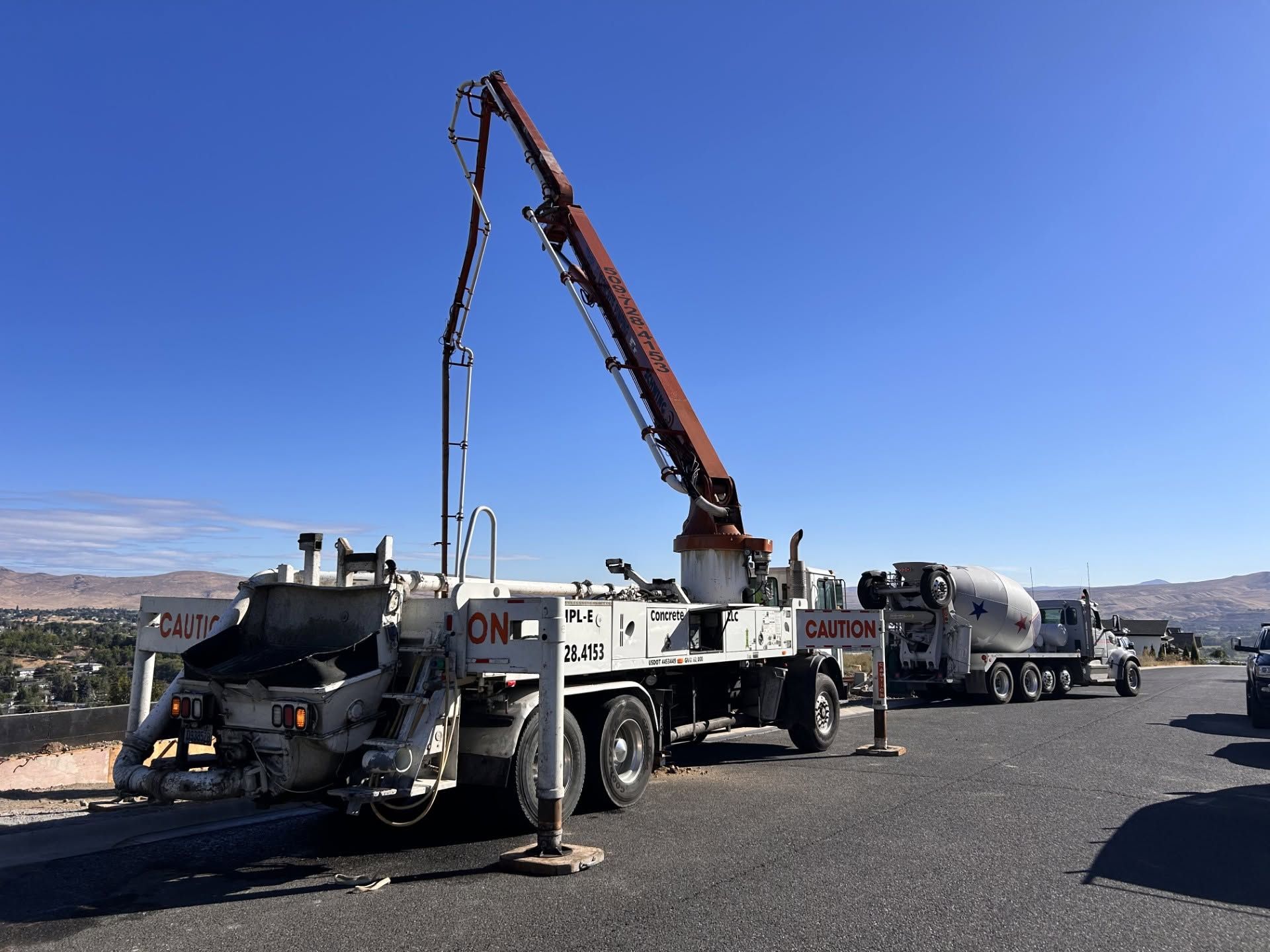
Boom concrete pumping uses a hydraulic arm mounted to a truck chassis to extend over structures, across terrain, and past obstacles that would otherwise stop a pour. The boom reaches areas that chutes cannot access and delivers concrete at a consistent rate that manual crews cannot match. Every site gets walked before the truck arrives to confirm ground bearing capacity under the boom stabilizers and identify overhead hazards that dictate boom movement sequence.
Schedule a site evaluation to confirm boom reach requirements and stabilizer placement options for your project.
What Happens During Boom Pump Placement
The boom truck positions on solid ground capable of supporting stabilizer loads, then the hydraulic arm extends to the pour location while the operator monitors reach angles and overhead clearance. Concrete flows through the boom pipeline at a controlled rate that matches your crew's finishing speed. The process eliminates the physical labor of hauling concrete across difficult terrain and reduces the risk of inconsistent mix caused by delayed manual transport.
After the pour completes, you'll notice that forms fill evenly without the segregation and surface voids common to wheelbarrow placement, and your finishing crew works at a steady pace rather than rushing to keep up with sporadic concrete delivery. The boom remains stationary once positioned, which protects finished site work and landscaping from the repeated traffic paths that chute pours and manual crews create.
Boom pumping does not include concrete finishing, form setup, or site grading. The service places concrete into your prepared forms, and your crew handles consolidation and surface work. On sites with multiple pour locations, the boom can reposition between placements if ground conditions allow, but each setup requires stabilizer confirmation.
What Contractors Ask Before Booking Boom Service
Boom concrete pumping questions come up frequently on Valley job sites where access or terrain creates delivery challenges.
What clearance does the boom need to avoid overhead power lines?
The boom operator walks the site before positioning to map power line locations and plan the reach sequence that maintains code-required clearance throughout the pour—this is done before the truck arrives, not guessed at on site.
How is the boom truck positioned on sloped or uneven ground?
Stabilizer pads get placed on solid, level bearing surfaces confirmed during the pre-pour site walk, and if the native grade won't support the load, timber cribbing or steel plates are specified in advance.
What is the maximum reach for the boom on residential projects?
Reach depends on boom model and required working radius, but typical residential pours within Yakima Valley neighborhoods fall well within standard boom capacity when stabilizers set on firm ground.
When should boom pumping be scheduled instead of chute delivery?
Boom pumping makes sense when forms sit beyond chute reach, obstacles block ground access, or the site layout prevents concrete trucks from approaching the pour location without damaging finished work.
How does weather affect boom concrete placement in Yakima?
Wind affects boom stability at full extension, and summer heat affects concrete workability regardless of placement method—early morning pours avoid the afternoon heat that shortens finishing time across the Valley.
Tripl-E Concrete Pumping is locally owned, fully insured, and operates as a boom-only specialist across the Yakima Valley. When your project requires reliable reach and zero surprises on pour day, arrange a pre-pour site consultation to confirm placement logistics and equipment requirements.