Pads Built to Bear the Load
Equipment Pad Pumping in Yakima for agricultural and industrial operations where thickness and load specs are not optional
Heavy machinery installed on agricultural properties in the Eastern Washington ag zone or industrial sites along the I-82 and I-90 corridors corridor rests on concrete pads that must meet full thickness and load-bearing specifications under every support point. Hand-placed concrete or chute delivery cannot reliably achieve consistent density and thickness across the entire pad area, creating weak spots under equipment loads that will crack or settle over time. Tripl-E Concrete Pumping operates boom pump equipment for Yakima Valley and surrounding area agricultural and industrial contractors who need precision concrete delivery for equipment pads where structural failure is not an option.
Boom pump delivery for equipment pads places mixed concrete directly into forms with controlled flow that maintains uniform thickness and eliminates the voids or inconsistencies that occur when concrete is wheelbarrowed or shoveled into place. The process matters because heavy equipment—whether ag machinery, industrial compressors, or processing equipment—concentrates load forces at specific points, and any pad thickness variation under those points compromises structural integrity. Fully insured operators familiar with Valley agricultural and industrial requirements understand that pad placement is a load-spec issue, not just a pouring task.
Arrange an on-site evaluation to review pad dimensions, equipment load points, and boom staging for your installation.
What You Notice Once the Pad Is Finished
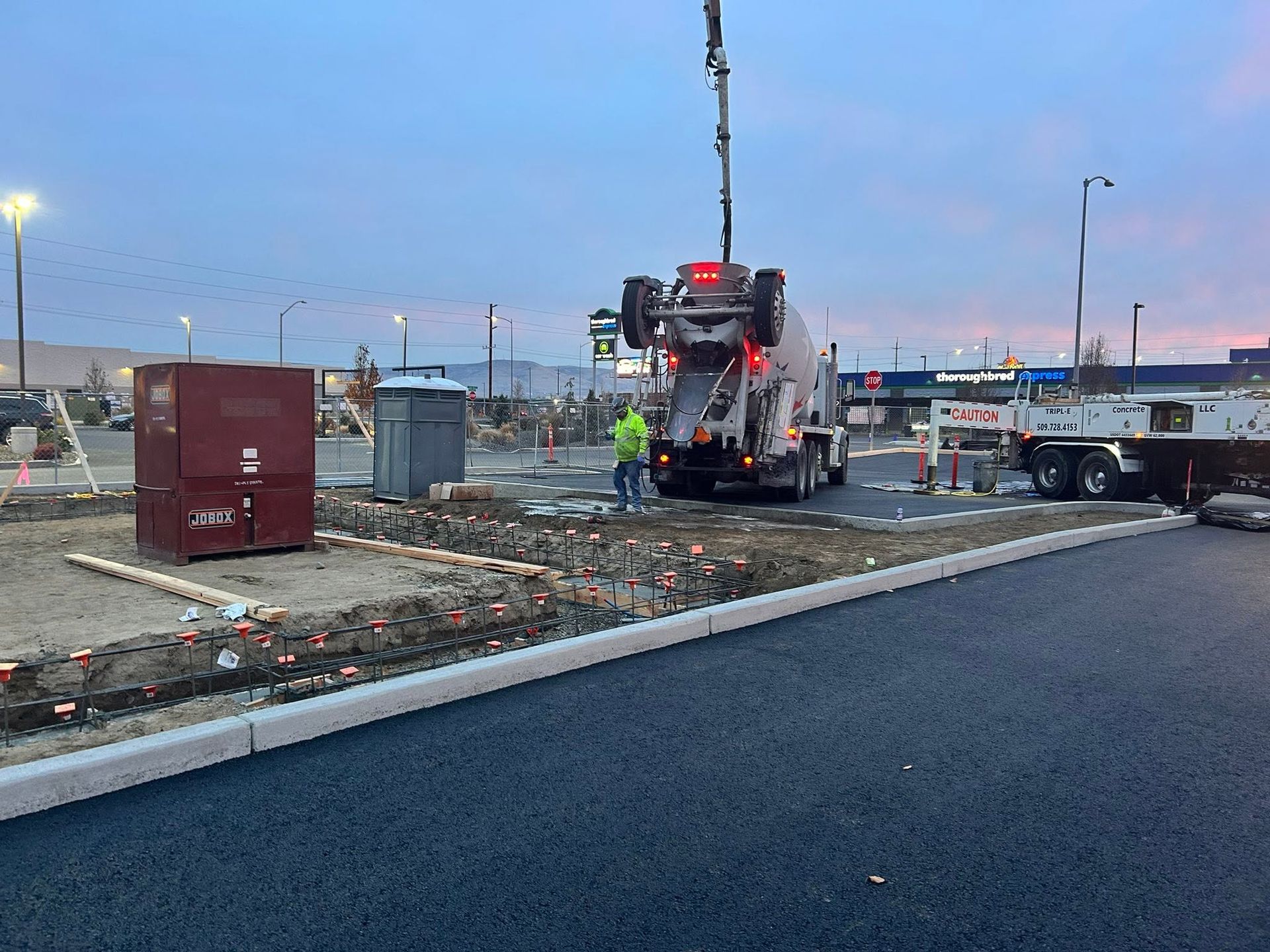
Equipment pad pumping starts with form review and boom reach confirmation—the operator verifies that the pump can access all sections of the pad and that the form structure will hold up under pumped concrete pressure. Once the pour begins, the boom delivers concrete directly into the form with consistent flow, filling from one end to the other without the stop-start gaps that hand placement creates. The operator monitors output to avoid overfilling or underfilling sections, ensuring the pad reaches the specified thickness across the entire footprint.
After placement, the pad surface shows uniform elevation without the low spots or mounded areas that indicate inconsistent placement. Equipment installed on the finished pad bears evenly across all support points, and the concrete density under high-load areas matches the rest of the slab. You won't see cracking at equipment anchor points or differential settling where one section of the pad was thinner than another—problems that surface months after installation when hand-placed pads fail under operational loads.
Pump service covers concrete delivery and placement only—finishing, screeding, and curing remain the responsibility of the concrete contractor or property owner. Pads supporting equipment with point loads exceeding standard slab specifications, or installations where thickness consistency affects equipment alignment, gain the most from boom pump delivery. Tripl-E Concrete Pumping coordinates with Valley concrete suppliers to schedule delivery timing that keeps the pour continuous and the pad placement uniform.
Answers to Frequent Service Questions
Property owners and contractors across the Yakima Valley ask similar questions when planning equipment pad installations, especially when the pad will support agricultural or industrial machinery with high load demands.
What makes boom pump delivery better than wheelbarrow or chute placement for equipment pads?
Pumped concrete maintains consistent density and thickness because it flows continuously into the form without manual handling that compacts material unevenly or leaves voids under critical load points.
How does the operator ensure the pad reaches full thickness at every point?
The boom delivers concrete in controlled passes across the form, and the operator monitors flow to avoid low spots—combined with proper screeding by the finishing crew, this produces uniform thickness across the pad footprint.
When should equipment pad pumping be scheduled relative to other site work?
Pad pumping works best after forms are fully braced and site access is clear for the pump truck—scheduling too early risks equipment damage to incomplete site work, while scheduling too late delays equipment installation timelines.
Why do Yakima Valley agricultural sites specifically benefit from pumped equipment pads?
Valley soil conditions and seasonal freeze-thaw cycles stress concrete pads with thickness inconsistencies, making uniform placement critical for long-term performance under heavy ag equipment loads.
What site access does the boom pump truck need for pad placement?
The truck requires stable ground for outrigger setup within boom reach of the pad—typically 100 feet or more depending on equipment—and clearance from overhead lines or structures that block boom extension.
Tripl-E Concrete Pumping is locally owned and family operated, serving Yakima Valley agricultural and industrial properties with honest and direct service. Confirm pump availability and discuss your equipment pad placement requirements by reaching us directly.