Footings Filled Completely the First Time
Footings & Footing Pumping in Yakima for full-depth consolidation in narrow trenches that manual placement cannot guarantee
Frost depth requirements in the Yakima Valley dictate that footings pour full-depth in one continuous pass to prevent the structural failure and frost damage that partial pours create when freeze-thaw cycles reach the joint. Narrow or deep footing trenches make complete concrete consolidation difficult with hand-rodding alone, and voids left behind compromise bearing capacity permanently. Boom pump delivery from Tripl-E Concrete Pumping fills footing trenches completely and consistently, ensuring the concrete consolidates without voids that manual placement methods cannot reliably eliminate.
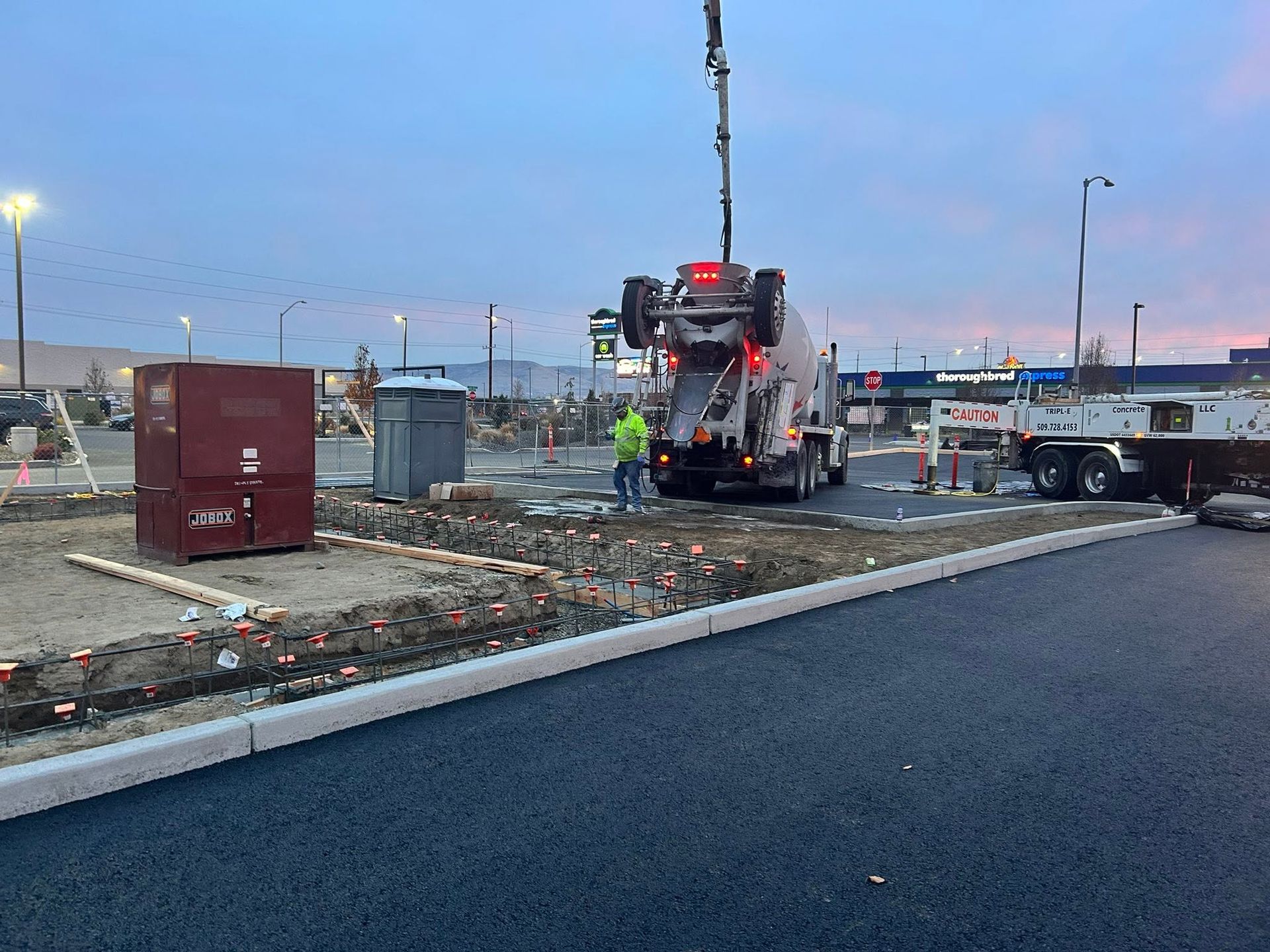
Footing pumping delivers concrete through the boom pipeline directly into trenches at a controlled rate that allows material to flow into corners, around rebar, and against trench walls without creating air pockets. The pump maintains steady flow throughout the pour so the entire footing cures as a single continuous mass, meeting the frost-depth and structural requirements that Valley building codes mandate. Manual placement and chute pours depend on crew effort to move concrete into narrow trenches, which introduces inconsistency that pump delivery removes.
Request a site evaluation to confirm trench access and pump positioning requirements for your footing layout.
What Full-Depth Footing Delivery Accomplishes
The boom extends over the trench line, and concrete flows in a continuous stream that fills the trench from bottom to top without interruption. Material consolidates under its own weight as the pour progresses, and vibration or rodding by your crew ensures contact with trench walls and embedment around reinforcement. The single-pass delivery prevents the cold joints that form when pours stop mid-trench and material begins to set before the next section arrives.
After the footing cures, the concrete forms a monolithic structure that distributes building load uniformly to the soil below, and frost penetration cannot exploit weak planes caused by pour interruptions or incomplete consolidation. Footings perform as engineered because the concrete filled the trench completely and bonded into a single structural unit. You avoid the settlement and cracking issues that voids and cold joints create over time as freeze-thaw cycles stress the foundation.
Footing pumping delivers concrete into prepared trenches but does not include excavation, rebar installation, trench shoring, or forming work. Your crew handles reinforcement placement and concrete consolidation during the pour. On projects with isolated pad footings rather than continuous perimeter trenches, the boom repositions between pads if site conditions and ground bearing allow.
Questions Before Starting Your Project
Footing pump questions frequently address trench width, consolidation methods, and how frost depth affects the Valley's foundation pours.
Why does Yakima Valley frost depth require continuous footing pours?
Frost penetration in the Valley reaches depths that create structural risk if footings contain cold joints—concrete must pour and cure as a single mass to prevent freeze-thaw damage at the joint plane.
How does boom pump delivery consolidate concrete in narrow footing trenches?
The pump delivers material at a controlled rate directly into the trench, allowing concrete to flow around rebar and into corners while your crew rods or vibrates to eliminate air pockets—hand-rodding alone cannot guarantee consolidation in trenches too narrow for vibrator head access.
What trench conditions are required before footing pumping begins?
Trenches must be excavated to specified depth and width, cleaned of loose soil and debris, and reinforced with rebar in place—the pump fills prepared trenches, and consolidation happens during delivery.
How is the boom positioned to reach footing trenches around a building perimeter?
The operator confirms stabilizer placement and boom reach during a pre-pour site walk, planning the sequence that covers the full trench length without repositioning mid-pour when possible.
When should builders use pump delivery instead of chute placement for footings?
Pump delivery makes sense when trench depth or width limits manual consolidation effectiveness, frost-depth codes require continuous pours, or site access prevents chute proximity to all trench sections.
Tripl-E Concrete Pumping is a fully insured, locally owned boom pump specialist with nearly ten years of industry experience serving Valley builders who cannot afford footing failures caused by incomplete consolidation or cold joints. Arrange a pre-pour consultation to confirm placement logistics and trench access for your foundation project.